Showing posts with label 1920s. Show all posts

Tuesday, January 26, 2016

Swell Ties to Crochet

My brother is an avid stamp collector and recently acquired a stack of old envelopes. In one, he found a pamphlet of instructions to crochet neckties from the1920s, which was given to me.the envelope is addressed to Miss Katharine B. Collier, of Vassar College, who, according to my Google searches, must have been Katherine Brownell Collier, a 1908 graduate who went on to earn a PhD from Columbia University with her dissertation entitled Cosmogonies of Our Fathers: Some Theories of the Seventeenth and Eighteenth Centuries. Why she had this pattern delivered to Vassar is a mystery, but I found no other Katherine B. Collier among Vassar alumni.   

The ties are made up in Corticelli Spool Silk thread, which the instructions tell us is "the very latest thing in swell neckwear". The envelope has Corticelli's cute kitten logo, and I date the publication after 1922, when the Nonotuck Silk Company merged with the Brainerd and Armstrong Company to form the Corticelli Silk Company. 


Friday, November 13, 2015

The Reinvention of Nadezhda Lamanova

I've been reading lately of a Russian fashion designer named Nadezhda (Hope) Lamanova (1861–1941) and wishing I could learn more of her life. She established a strong reputation as a couturier in the early 20th century, designing gorgeous gowns for Empress Alexandra and other members of the Imperial court. 


Then came the Russian Revolution. Her position with the court could have very well earned her prison time or cost her her life, but somehow Lamanova reinvented herself as the Dressmaker to the People. There is no starker contrast than that of her lavish court designs and the almost crude patterns she created for the new Russian proletariat. 


One reason for the drastic shift was to distance the new regime from the opulence of the Romanovs, but the other was far more practical. The vast majority of Russian women were struggling to feed and clothe their families. There was little reason to design clothing no one would have opportunity to wear; work clothes and one presentable dress was what women needed. Scarcity of fabric was a challenge. Lamanova remembered that in designs that utilized goods women might have on hand: embroidered towels and colorful headscarves. In1925, Lamanova collaborated with sculptor Vera Mukhina to produce a booklet, Art In Daily Life, with extremely simple patterns for sewing garments. 


Other women entered the clothing design field, notably Varvara Stepanova, Alexandra Ekster (Exter), and Liubov Popova. One open arena for them was in theater costuming. Theater was a tool for communist propaganda, so lest we imagine costumes for Chekhov or Turgenev, characters were based on stereotypes of groups of strong, identically-dressed workers confronting decadent, flashy, foreign capitalists.


Stepanova, in particular, designed bold, geometric outfits in the Constructivist style. 

Stepanova sport suits
Varvara Stepanova overalls


Liubov Popova coat sketch


Alexandra Ekster design


Early in the revolutionary period, women's fashion and home-making magazines were launched, but soon folded, as one source so aptly put it, "for lack of ideas". A Soviet attempt at the Paris fashion show of 1924 was met with much amusement. Because of the lack of luxury fabrics, clothing had been made with anything available, including the rough cotton sacking used to wrap bales.

Despite this, designers like Lamanova were able to inject a small share of fashion into the lives of Soviet women during those very difficult years. Give us bread, and give us roses.

Thursday, February 13, 2014

HSFC #3 PINK! Inspiration


Now pink is not a color I wear, unless it's a very coral pink. But, do you know who loves pink? Every little girl on the planet! What little girl doesn't wish she had a silky pink dress with ruffles and bows and some sort of flower thing going on, and while we're at it, matching ruffly bloomers so her panties don't show when she pirouettes? I happened to have a very old piece of silky pink fabric I had no idea what to do with.  With the year 1920 in mind, I found a goldmine of inspiration online.

I colorized this photo of an adorable toddler, but you just know that dress was originally pink. This type of dress was quite popular. The style is very simple: a lined slip-on dress with bound neckline and sleeves, and a very deep hem which can be taken down as Susie grows.  The string tie at the neck tightens or loosens the neckline.


This dress is a bit more detailed than I care to do, but I liked the fabric flower at the shoulder. I want to add that to my little dress.

An interesting bit of history: the idea that pink  is for girls and blue for boys is a 20th century concept. In the 19th century, it was often advised that mothers dress boys in pink, as it was a "strong" color, and girls in a serene blue. In non-western cultures, it is still not widely known or accepted. When I was a teacher at an International School in SE  Asia, I was always amused when families returned from summer holidays with new school clothes for the children. So often, Mummy would choose lovely pink outfits, from running shoes, socks, and upwards, for her little boy.  


Those were the days of talented children in silent films, and one I think was so cute was Baby Peggy Montgomery. I just love her mischievous dark eyes and bobbed hair, and her ruffly dress!


Sunday, February 2, 2014

#2 Innovation -- Motoring Coat In Progress


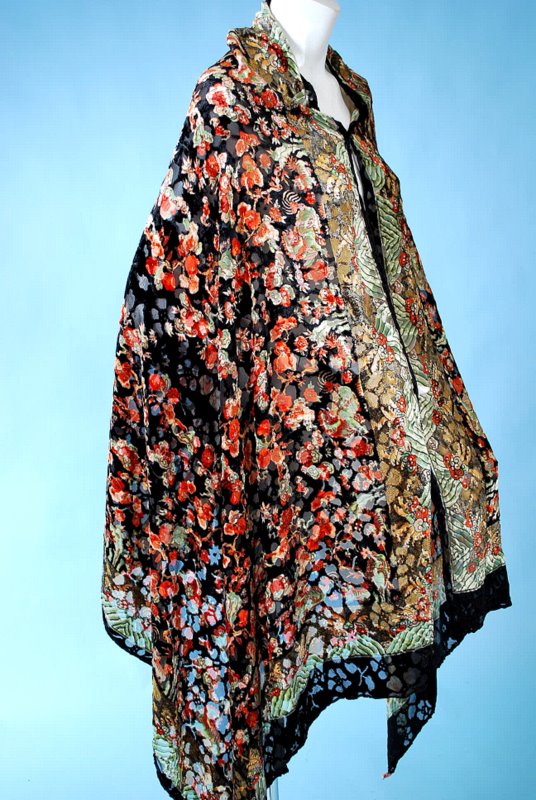
I've bitten off more than I could chew for this fortnight! I spent a lot of time constructing the basic coat and still have to sew in the sleeves and front pocket, and put on the detachable collar. I am happy with the coat, black and severe as it may be. Dad calls it my mourning dress. The collar is a beautiful velvet scarf I've had in a box for ages. Very 1920s - devoré velvet in a lovely paisley-ish pattern of black, rose, green, gold, and purple, with a slinky black fringe on the ends. Devoré was a process invented in the 1920s, where chemicals were applied to eat away (devour) the velvet pile in patterns. The gathered scarf adds a bit of glamor and warmth to the very basic coat. It's Double Innovation -- clothes for driving in cars and a new process for fabric!


Velvet shawl collar
Front of coat

Back, showing  buttoned
vent pleat


The Challenge: Innovation - The automobile and clothes to wear while in it, the devoré velvet process.

Fabric: 100% linen fabric for the coat, velvet collar
Pattern: self-drafted from photographs of coat patterns.
Year: early 1920s
Notions: Thread, 15 abalone shell buttons, bias tape for attaching collar, snaps
How historically accurate is it? Pretty accurate.
Hours to complete: Too many
First worn: Not quite finished.
Total cost: About US$10 from thrift store and notions on hand.

So I'm putting this in the closet for a bit, because I want to dive into the "Pink" category -- Challenge #3 Pink.